"She Carries The Morning©"
Release Date: Coming Soon!
Lyrics by M. S. McKenzie | Performed by Songs Across America, Protected by Copyright
~ Associated State Links ~
"She Carries The Morning"
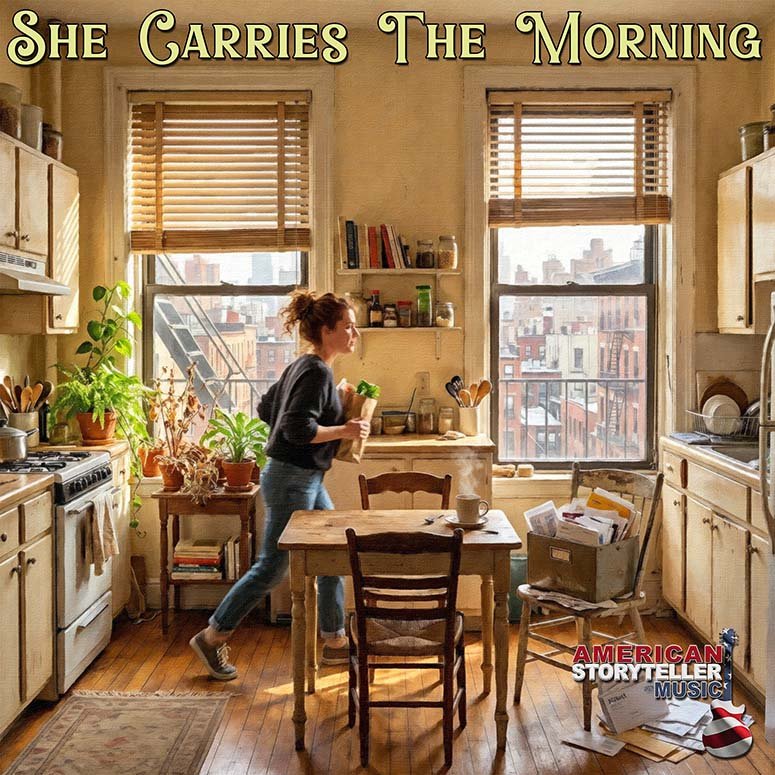
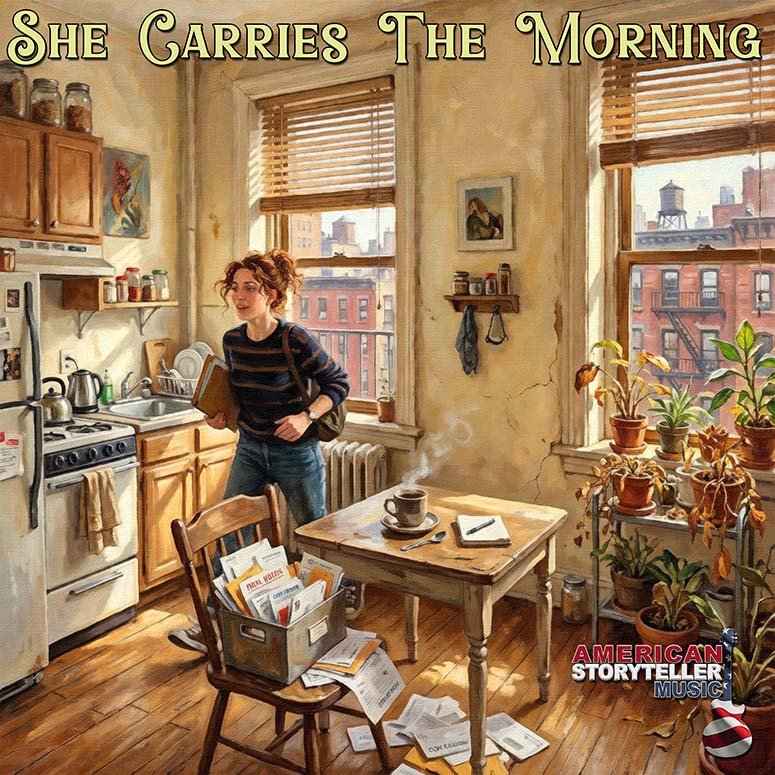
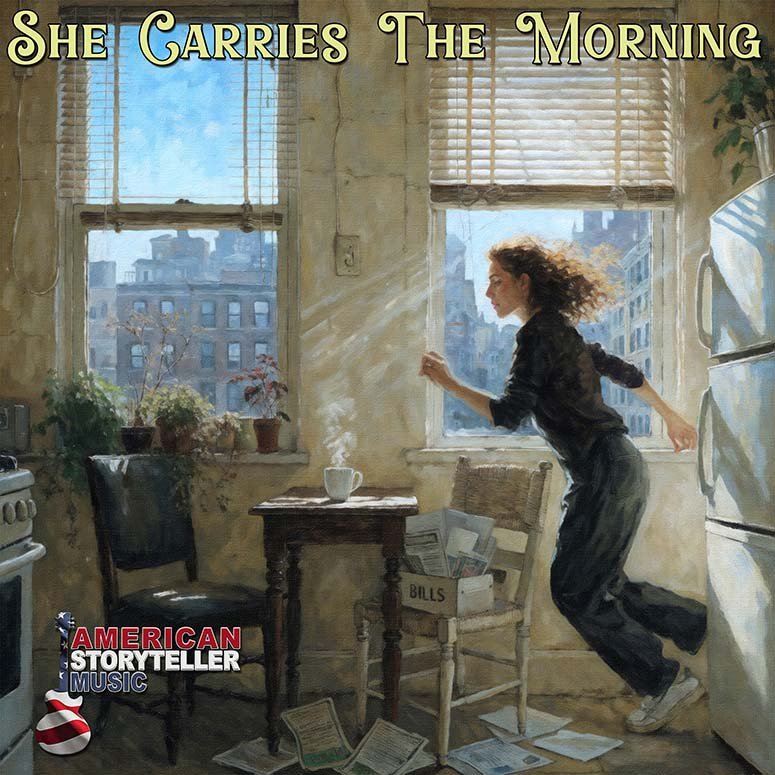
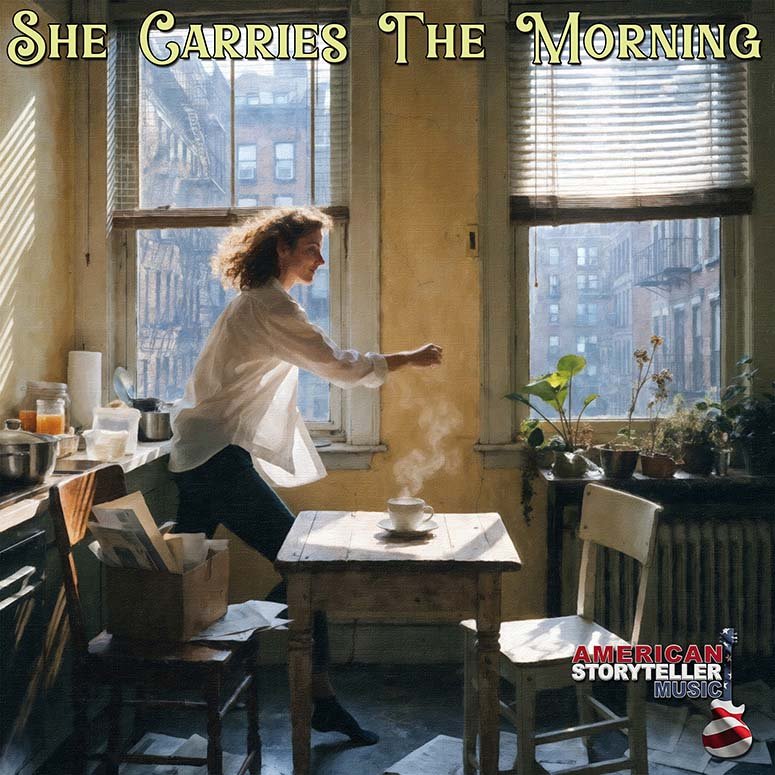
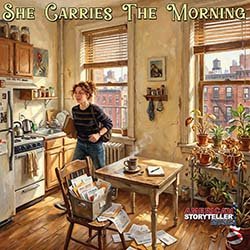
I wrote "She Carries the Morning" for a very specific kind of New Yorker, the one who loses her keys, misses trains, changes plans a dozen times, and somehow still walks into every day like it's already a good one. She rises late in a fourth-floor walk-up, with sunshine through the blinds, a cup of coffee, a broken heel, a dozen dreams got left behind, and I wanted her ordinary chaos to feel completely charming rather than something she needs to apologize for.
The story behind the song is the pre-chorus's honesty, she's never learned to travel straight, she often gets lost and calls it fate, every wrong turn opens up a door. I didn't want her disorganization to be a flaw the song fixes by the end. I wanted it to be reframed as its own kind of faith, a willingness to trust that even the mistakes are leading somewhere worthwhile.
What I care about most is the chorus's claim, she carries the morning in her heart, rain or shine, down New York streets, because I wanted her optimism to be portable, something she brings with her rather than something the city gives her. Songs Across America has plenty of songs about people changed by New York. This one is about someone who would carry that same light into any city she happened to wake up in.
Bright, buoyant indie-pop built on a warm, singable chorus, structured as a day in the life of a cheerfully scattered New Yorker.
Optimism as something carried rather than earned, the charm of a wonderfully disorganized life, New York as backdrop rather than cause, and faith that wrong turns can still open the right doors.
Primary Subject:
A young woman living in New York City, cheerfully disorganized and endlessly optimistic despite her daily mishaps.
Mood:
Bright, warm, and buoyantly optimistic throughout.
Some people carry their own morning with them wherever they go, missed trains and lost keys and all, and that stubborn, portable optimism is worth more than getting everything right.
[Instrumental Intro]
[Verse 1]
She rises late in a fourth-floor walk-up
With sunshine through the blinds
A cup of coffee, a broken heal
A dozen dreams got left behind
She laughs at bills on the kitchen chair
Says the world can wait another day
Ties a ribbon round her windblown hair
And lets 5th Avenue lead the way
[Pre-Chorus]
She's never learned to travel straight
She often gets lost and calls it fate
Every wrong turn opens up a door
Always believing there's something more
[Chorus]
She carries the morning in her heart
Rain or shine, down New York streets
She's always humming a musical tune
Every stranger is someone she might meet
Oh, she carries the morning in her heart
Even after the night has left its scars
She may stumble through the hard days
But she always knows brighter days aren't far
[Instrumental Turnaround]
[Verse 2]
She misses trains and loses keys
Changes plans a dozen times
She'll spend her last ten dollars
On a street musician's tired rhymes
By a window near the East River
She draws tomorrow on a paper page
Says every life is just a story
And tonight we get to choose the stage
[Pre-Chorus]
She has cried when no one knew
But still finds something kind to do
Every bruise becomes a lesson learned
Every dead-end is another road to turn
[Chorus]
She carries the morning in her heart
Rain or shine, down New York streets
She's always humming a musical tune
Every stranger is someone she might meet
Oh, she carries the morning in her heart
Even after the night has left its scars
She may stumble through the hard days
But she always knows brighter days aren't far
[Instrumental Breakdown]
[Bridge]
At times I've seen her come undone
Then gathers up all the broken pieces
She never tries to hide the cracks
And lets the light shine through the seams
And I know that loving her means learning
Not to ask where she has been
She was never made for cages
But somehow she still lets me in
[Full-Band Rise]
[Final Chorus]
She carries the morning in her heart
Rain or shine, down New York streets
She's always humming a musical tune
Every stranger is someone she might meet
Oh, she carries the morning in her heart
Even after the night has left its scars…
She may stumble through the hard days
But she always knows brighter days aren't far
[Post-Chorus]
Oh, She carries the morning deep inside
And when I forget how hope begins…
She finds me somewhere in the silence
And lets all that New York City sunlight in
[Outro]
She carries the morning
Wherever she goes…
She carries the morning
More than she'll ever know
[Instrumental Outro]
“She Carries the Morning” is a warm, cinematic adult contemporary and pop-rock character portrait about a free-spirited New York woman whose optimism survives disappointment, financial struggle, emotional wounds, and the unpredictable rhythm of city life. Through details such as a fourth-floor walk-up, Fifth Avenue, missed trains, street musicians, the East River, unpaid bills, and crowded sidewalks, the song creates the image of someone who may never have mastered conventional stability but possesses an extraordinary ability to rediscover hope.
The song’s title captures the defining quality of its central character. She “carries the morning” not because her life is always bright or easy, but because she keeps some portion of morning’s promise inside her even after difficult nights. Morning represents renewal, possibility, warmth, and another chance to begin. She carries those qualities through the city and shares them, often without realizing it, with the people who encounter her.
Although the song initially appears to be a playful portrait of an eccentric and somewhat disorganized woman, it gradually reveals deeper emotional complexity. She is not carefree because she has never suffered. She has known disappointment, loneliness, financial insecurity, and moments when she has completely fallen apart. Her optimism is therefore not innocence. It is a form of courage.
The instrumental introduction could immediately establish the song’s late-1970s or early-1980s adult contemporary character. Warm electric piano, clean electric guitar, soft bass, brushed or lightly struck drums, and a subtle string arrangement would create the feeling of sunlight entering a New York apartment. A brief melodic saxophone or guitar phrase could introduce the musical theme later associated with the chorus.
The first verse begins in a fourth-floor walk-up, placing the character in an ordinary and slightly worn urban setting. She is not living in luxury or looking down from a fashionable penthouse. She occupies a modest apartment reached by several flights of stairs, suggesting both financial limitation and the daily physical effort required by city life.
She rises late, allowing the morning to reach her through the blinds before she fully enters the day. This small detail immediately communicates something about her personality. She does not live according to a rigid schedule, and she may not always move at the pace expected of her. Yet sunlight still finds its way into the room.
The cup of coffee, broken heel, and abandoned dreams provide a compact summary of her life. The coffee is part of the ordinary morning ritual, while the broken heel suggests wear, inconvenience, and perhaps a glamorous life she cannot quite maintain. The line would be written most naturally as “a broken heel,” rather than “heal.”
The “dozen dreams” left behind suggest that she has changed direction many times. She may have pursued careers, relationships, creative ambitions, or different versions of herself that never fully developed. Yet the lyric does not portray those abandoned dreams as proof of failure. They are simply part of the road she has traveled.
The unpaid bills on the kitchen chair introduce practical pressure. They are visible and cannot be ignored forever, but she refuses to allow them to determine the entire emotional tone of her day. Her laughter may be partly defensive, but it is also an act of resistance. She will deal with reality, though not before allowing herself to live.
“Says the world can wait another day” captures both her charm and her irresponsibility. She postpones problems, changes plans, and often refuses to approach life in the orderly way other people might prefer. This makes her lovable but also difficult. The song does not erase those contradictions.
Tying a ribbon around her windblown hair gives her a visual signature. She improvises rather than perfects. The ribbon may not fully control her hair, just as plans never completely control her life, but it adds personality and intention to the disorder.
When she allows Fifth Avenue to lead the way, New York becomes an active participant in the song. She does not appear to have a fixed destination. She steps into the city and allows its streets, people, sounds, storefronts, and unexpected encounters to determine the shape of the day.
The first pre-chorus explains her philosophy of movement. She has “never learned to travel straight,” which can refer both to physical navigation and the course of her life. Her route is filled with mistakes, detours, revisions, and spontaneous changes.
“She often gets lost and calls it fate” is an affectionate description of the way she transforms inconvenience into meaning. Rather than admitting that she has missed a turn or failed to plan, she imagines that the mistake has led her somewhere necessary.
This habit might frustrate a more practical companion, but it also allows her to remain open to discovery. A wrong turn can reveal a café, musician, conversation, neighborhood, or possibility that a carefully planned route would have missed.
“Every wrong turn opens up a door” summarizes her gift for reinterpretation. Events that appear to be failures become entrances into something unexpected. She does not deny that things go wrong. She simply refuses to believe that a mistake must be the end of the story.
The final pre-chorus line, “Always believing there’s something more,” identifies the source of her momentum. She believes there is another opportunity beyond the next corner, another person worth meeting, another dream worth trying, and another version of life still waiting to be discovered.
The chorus reveals why this woman affects the narrator so deeply. “She carries the morning in her heart” transforms her personality into something luminous and almost tangible. Morning is not simply around her. It exists within her.
“Rain or shine, down New York streets” places her optimism within changing conditions. The city can be bright, romantic, crowded, exhausting, wet, cold, or unforgiving. Her spirit does not depend entirely upon the weather or circumstances.
Her constant humming suggests that music is one of the ways she protects and expresses herself. She carries her own soundtrack through the city, turning ordinary movement into something cinematic. The tune may also indicate that she has an inner life richer than what others see.
“Every stranger is someone she might meet” captures her openness toward people. Most urban commuters learn to avoid eye contact and move efficiently through crowds. She instead sees each stranger as a possible story, friend, connection, or moment of kindness.
The line is charming, but it also explains why she remains emotionally vulnerable. A person who remains open to everyone risks disappointment, rejection, exploitation, and loss. Her warmth is powerful precisely because the world has given her reasons to become more guarded.
The second half of the chorus acknowledges those reasons. The night has left scars, meaning she has experienced pain that cannot simply be erased by morning. The scars may come from relationships, family history, poverty, personal mistakes, or the loneliness hidden beneath her sociability.
She stumbles through hard days rather than gliding above them. This distinction keeps the character believable. She loses balance, becomes overwhelmed, and sometimes fails. Her optimism does not prevent hardship.
What distinguishes her is the conviction that brighter days are never impossibly far away. She may not know exactly when they will arrive or what they will look like, but she remains oriented toward them.
The instrumental turnaround gives the music room to carry that hope forward. Electric piano, saxophone, or clean guitar could restate the chorus melody while the rhythm section gently transitions into the second verse. The arrangement should feel like the camera moving from one neighborhood scene into another.
The second verse develops the woman’s charming disorganization. She misses trains, loses keys, and changes plans repeatedly. These habits make her life less efficient but also reinforce her resistance to rigid structure.
Missing trains is particularly fitting in a New York song. The subway represents schedules, direction, and the collective momentum of the city. She repeatedly fails to match that rhythm, yet somehow continues moving.
Spending her last ten dollars on a street musician reveals both generosity and impulsiveness. The amount matters because it is not spare change. She gives away money she may need because she recognizes the dignity, fatigue, and creative effort of another person.
The musician’s “tired rhymes” suggest someone who has been performing for hours, perhaps ignored by most passersby. She notices the person behind the performance and responds instinctively.
This scene also implies that she values art more than security. That may contribute to her unpaid bills and unstable life, but it is inseparable from the compassion that makes her special.
The setting then shifts to a window near the East River. Here she becomes an artist or dreamer herself, drawing tomorrow on paper. The image suggests sketching, writing, planning, or simply imagining a future not yet formed.
The river is an appropriate companion to this moment because it is always moving. Like her life, it cannot be held in one shape. She looks outward and invents possibilities while the water passes below.
“Says every life is just a story” reveals her belief that identity can be interpreted and revised. A life is not merely a fixed collection of events. It is also the meaning a person gives those events.
“And tonight we get to choose the stage” extends that metaphor into performance. People may not control every circumstance, but they can choose where and how to begin again. The city provides countless stages: apartments, sidewalks, cafés, parks, clubs, subway platforms, and private rooms where lives change direction.
The second pre-chorus reveals more clearly that her brightness conceals private suffering. “She has cried when no one knew” shows that she does not always share her pain, even though she appears emotionally open.
Her kindness is therefore not produced by an easy life. She chooses to do something kind while carrying grief that others may never recognize.
“Every bruise becomes a lesson learned” presents pain as instructive but not desirable. She does not romanticize being hurt, yet she refuses to allow hurt to remain meaningless.
“Every dead-end is another road to turn” returns to the song’s travel metaphor. A dead-end does not prove that the journey is over. It simply requires another direction.
The repeated chorus now carries greater emotional weight. The listener understands that the morning she carries has survived hidden tears, abandoned dreams, and hard lessons. Her optimism becomes an achievement rather than merely a personality trait.
The instrumental breakdown can provide a more expressive and rhythmically adventurous moment before the bridge. Saxophone, electric guitar, piano, and strings could exchange phrases, suggesting the chaotic yet beautiful energy of New York.
The bridge changes the song’s perspective by bringing the narrator more directly into the story. Until this point, he has mainly observed and admired her. Now he reveals that he has witnessed her collapse.
“At times I’ve seen her come undone” strips away the romantic idealization. He has seen the moments when optimism fails, emotional control disappears, and her carefully gathered sense of self falls into pieces.
She then gathers those broken pieces herself. The wording is important because the narrator does not claim to repair or rescue her. She possesses the resilience to rebuild, even if he remains nearby.
“She never tries to hide the cracks” suggests unusual honesty. She does not pretend that healing has restored her to an untouched condition. Her history remains visible.
The next line transforms those cracks into openings through which light can pass. This image recalls the idea that damaged objects can become more beautiful when their breaks are acknowledged rather than concealed.
The light is not present despite the cracks. It enters through them. Her vulnerability allows warmth, empathy, humor, and understanding to reach other people.
The second half of the bridge defines what loving her requires. The narrator is learning not to demand a complete account of where she has been. This may refer literally to her wandering nature, but it also refers to emotional history.
He recognizes that loving her does not grant him ownership over every past experience or explanation. Trust means allowing parts of her life to remain hers.
“She was never made for cages” returns to the song’s theme of freedom. The cages may be relationships, expectations, conventional careers, schedules, social judgment, or attempts to make her more manageable.
The line also warns the narrator that love cannot become control. To keep her close, he must not imprison the qualities that first drew him toward her.
“But somehow she still lets me in” is one of the song’s most intimate lines. The narrator does not capture or possess her. She chooses to make room for him.
That voluntary trust means more because she values freedom so deeply. Her love is not dependence. It is an opening offered by someone who could continue traveling alone.
The full-band rise after the bridge should feel like emotional release. Drums, bass, strings, electric guitar, and harmony vocals can gradually build toward the final chorus, reflecting both her resilience and the narrator’s growing understanding.
The final chorus repeats the central portrait, but its meaning has matured. The woman carrying morning is no longer merely a charming city wanderer. She is a person who has broken, rebuilt herself, and still chosen openness.
The post-chorus introduces the narrator’s dependence upon her hope. When he forgets how hope begins, she finds him in silence and allows New York sunlight to enter.
This reverses the apparent emotional dynamic. Earlier, the narrator seemed like the more stable observer watching an unpredictable woman. Here, it becomes clear that her inner brightness often sustains him.
She may lose keys, miss trains, ignore bills, and change plans, but she understands something about renewal that he sometimes forgets.
The phrase “finds me somewhere in the silence” suggests that she recognizes his hidden sadness just as he recognizes hers. She does not need a detailed explanation. Her presence itself creates an opening.
New York City sunlight becomes both literal and symbolic. It enters between buildings, through apartment windows, and across crowded streets, transforming ordinary surfaces. In the same way, she brings warmth into parts of the narrator’s life that have become closed or shadowed.
The outro simplifies the message into a repeated declaration. She carries the morning wherever she goes, meaning her influence is not limited to one neighborhood, relationship, or stage of life.
“More than she’ll ever know” adds tenderness and a trace of sadness. She may not understand how many people she has encouraged through a smile, conversation, impulsive gift, song, or simple act of attention.
The narrator sees a value in her that she may not fully recognize. Her life may appear disorganized from the outside, but the emotional effect she has on others is profound.
The instrumental outro could return to the warm electric-piano theme heard at the beginning, now joined by fuller strings or a lyrical saxophone. The music should gradually soften rather than conclude with a dramatic stop, leaving the impression that she continues walking beyond the final scene.
Musically, “She Carries the Morning” is especially well suited to a late-1970s or early-1980s adult contemporary and soft pop-rock arrangement. Its sound could combine warm electric piano, clean guitar, melodic bass, brushed or restrained drums, strings, and a tasteful saxophone.
The verses should remain conversational and cinematic. The vocal needs warmth, affection, and a slight sense of amusement. The singer loves this woman not despite her contradictions but partly because of them.
The pre-choruses should gradually lift in melody and harmony, reflecting her ability to turn wrong directions into possibility. A rising bass line or soft string swell could lead naturally into each chorus.
The chorus should open broadly but remain graceful. Layered harmony vocals on “She carries the morning in her heart” could create a luminous, memorable hook.
The phrase “rain or shine, down New York streets” could be supported by a stronger snare and wider instrumentation, giving the music the movement of someone stepping confidently onto the sidewalk.
The instrumental turnaround might feature a melodic saxophone phrase, while the later breakdown could allow the saxophone and electric guitar to interact with piano and strings.
The bridge should initially reduce the arrangement, perhaps to piano, voice, and low strings, allowing the vulnerability of “I’ve seen her come undone” to stand clearly. The music can then grow beneath “she still lets me in.”
The final chorus should be the fullest and most emotionally expansive part of the song. Higher harmony vocals, stronger drums, a sustained guitar line, and sweeping strings could convey the cumulative emotional effect without turning the song into an oversized power ballad.
The post-chorus should feel like a private realization after the public sweep of the chorus. The instrumentation might briefly pull back beneath “when I forget how hope begins” before rising again on “lets all that New York City sunlight in.”
At its heart, “She Carries the Morning” is a song about resilience expressed through ordinary behavior. Its heroine does not deliver speeches about hope or present herself as inspirational. She simply continues moving, humming, giving, imagining, and meeting people.
Her flaws are essential to the song. She is late, disorganized, impulsive, financially strained, emotionally scarred, and resistant to control. Removing those qualities would make her less believable and would weaken the meaning of her optimism.
She carries morning because she knows the night. She believes in brighter days because she has survived darker ones. She notices strangers because she understands loneliness, and she gives to tired artists because she knows what it means to keep creating when recognition is uncertain.
The song is also a mature love story. The narrator gradually learns that loving her does not mean correcting her wandering path or protecting her from every mistake. It means respecting her freedom, accepting the visible cracks in her life, and recognizing the light that enters through them.
New York City is more than a backdrop. Its chaos mirrors her unpredictability, its diversity encourages her openness, and its constant reinvention reflects her belief that another beginning is always available.
“She Carries the Morning” ultimately celebrates people whose brightness is not loud or perfect but persistent. They may not have solved their own lives, yet they make the lives of others feel more possible.
The song’s deepest message is that hope is not the absence of scars. It is the decision to keep letting in the light. The woman at the center of the song carries that light through apartments, streets, stations, riverside windows, and relationships, often unaware that her imperfect courage has become morning for someone else.




















.jpg)
